Fresh vs UHT Plant Milk in Indonesia: The Real Trade-Off
Fresh vs UHT plant milk in Indonesia is a cold chain decision before it is a nutrition decision. Both formats are safe, the main nutrients come through both processes, and neither one needs a preservative to last. The format you can actually keep cold is usually the better buy.
A UHT carton carries the risk for the producer until you break the seal. A fresh bottle hands that risk to your fridge, your scooter ride home, and your week. That is the trade, and your kitchen decides it more than the label does.
What the two words mean on an Indonesian label
The Indonesian regulator spells both processes out. Pasteurisation heats the drink to roughly 72 °C for 15 seconds, or 63 °C for 30 minutes, then cools it. UHT runs far hotter, about 135 to 150 °C, but only for two to five seconds before the pack is filled aseptically; the BPOM explainer on pasteurised and UHT milk lays out both numbers.
The consequence is storage, not status. Pasteurisation knocks down the pathogens and leaves some spoilage organisms alive, so the product stays cold from the plant to your fridge. UHT plus an aseptic pack leaves nothing alive to grow, so the carton can sit at room temperature for months.
- Pasteurised (susu pasteurisasi): a fridge product with a short life, cold chain the whole way.
- UHT (susu UHT): a commercially sterile product in a sterile pack, shelf stable until opened.
- The preservative myth: BPOM states plainly that UHT keeps because of heat plus aseptic packing, not additives.
- After opening: both formats become perishable and both belong in the fridge, finished in days.
- What you are buying: a carton buys distribution convenience, a chilled bottle buys a shorter supply chain.
The naming line almost nobody mentions
In November 2025, BPOM issued Circular Letter 7 of 2025 on the use of the term “milk”, and almost no guide outside Indonesia mentions it. The rule is narrow: “susu” is reserved for liquid from dairy animals, with coconut milk and soy drinks as the two named exceptions. Nut, grain, cereal and other legume drinks may not carry “milk” as their type name.
Existing labels have 18 months to adjust, so some imported cartons here are mid-relabel. That makes the Indonesian type name the most honest line on the front of the pack, since “minuman sari kacang mede” tells you the base and the format in one breath.
The English word beside it is branding, and our own bottle uses “mylk” for exactly that reason. Read the Indonesian product name and the storage instruction, and treat the headline as decoration.
Who carries the cold chain
Every chilled product is a chain of custody: producer, truck, shop chiller, your bag, your fridge, your week. The fresh format works only while every link holds, and in Bali the weak links are the last two.
| Question | Fresh pasteurised bottle | UHT carton |
|---|---|---|
| Heat treatment | about 72 °C for 15 seconds | 135 to 150 °C for 2 to 5 seconds |
| Before opening | fridge at 1 to 4 °C, weeks not months | room temperature, several months |
| After opening | days, best finished early | days, per the pack instruction |
| Who holds the risk | you, from the shop to the last pour | the producer, until the seal breaks |
| What fails first in Bali | the ride home and the fridge door | a carton left out on the counter |
| Where you find it | chillers, health shops, direct delivery | minimarkets, grocers, online |
| Fits a household that | drinks milk most days | drinks slowly, or travels |
Read that as a risk transfer. The carton is not a worse drink, it is a drink whose freshness was paid for in advance, in heat and in packaging. The chilled bottle did not pay that cost, so somebody else has to.
Chilled distribution means short routes, small batches and cold storage, which is why the two formats rarely land at the same price per litre. We broke that arithmetic down in what plant milk costs in Bali.
What the heat changes, and what it does not
For dairy the argument is mostly settled, and BPOM says so: protein, fat, calcium and phosphorus come through largely intact, with some heat-sensitive vitamins such as vitamin C and parts of the B group dipping slightly. A UHT carton is not a nutritionally empty product.
Plant drinks are the less even case. A University of Copenhagen study with the University of Brescia, published in Food Chemistry in December 2024, tested ten commercial plant drinks and two UHT cow’s milks. At UHT temperatures sugars and proteins react in the Maillard reaction, which binds lysine and leaves lower available essential amino acids, and all ten plant drinks showed it.
Two caveats matter here. The study looked at UHT plant drinks from three Scandinavian producers, not at Indonesian cartons, and it did not test pasteurised plant milk at all. What it supports is a direction, not a scoreboard.
A Bali kitchen is the harder half
Ambient temperature here sits around 26 to 31 °C year round, and a fridge door runs warmer than the shelf behind it. A chilled bottle that spent forty minutes in a hot bag on the way home from Canggu has already spent part of its life, and no date on the cap accounts for that.
So the fresh side is a routine, not a purchase: buy weekly, buy cold, store it at the back of the fridge, finish it while it still tastes like itself. The spoilage mechanics live in our guide to why plant milk spoils fast in Bali, and the short version is that the cold chain matters more than the date.
Choose the UHT carton if:
- You have no reliable fridge, or you are in a villa for a fortnight.
- You want a carton in the cupboard as a backup you do not have to think about.
- You drink plant milk slowly, so a fresh bottle would expire before you finish it.
- You are travelling to Java or another island and want something that survives the trip.
Choose the fresh bottle if:
- Your fridge holds temperature and you drink milk most days.
- You are settled in one corner of Bali and can keep a weekly buying rhythm.
- You want an ingredient list you can finish reading without a lookup.
- You care about taste in the glass more than a cupboard that stocks itself.
Where Worry Nut fits
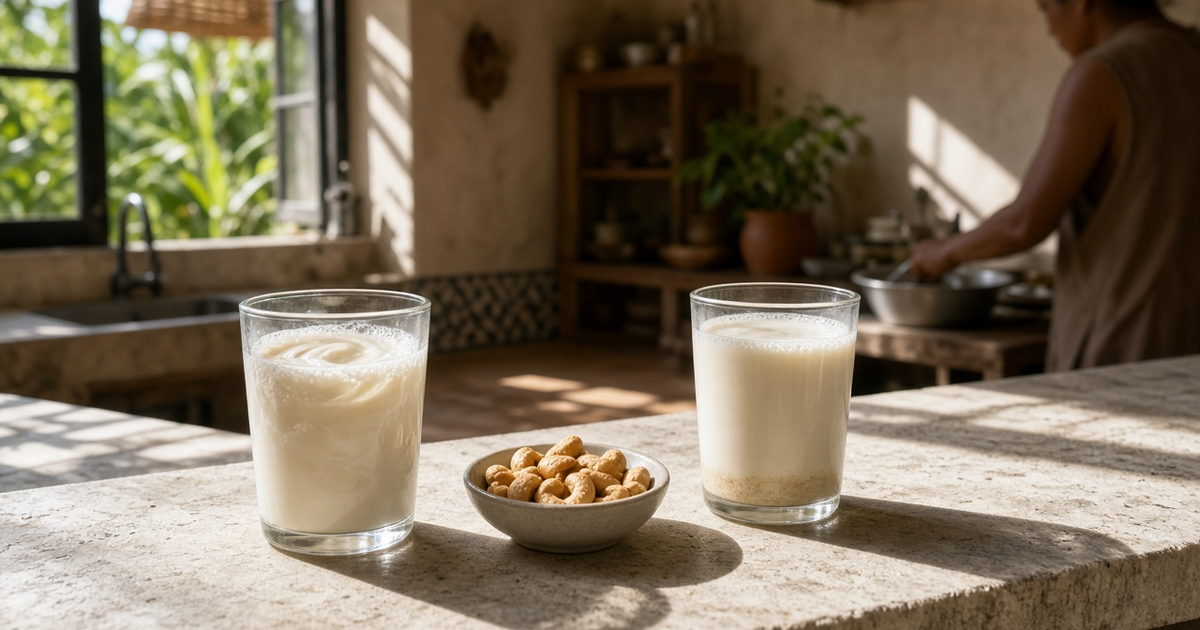
Worry Nut Fresh Cashew Mylk is made in Ubud, Bali, in small batches, and it sits firmly on the fresh side of this table. It is pasteurised gently rather than UHT treated, bottled in opaque food-grade HDPE rather than a carton, and it keeps 21 days unopened at 1 to 4 °C, best finished within four days of opening.
The recipe is six ingredients: filtered water, Indonesian cashews, Central Java coconut sugar, Kusamba sea salt, sunflower lecithin and Bali vanilla. No gums, no refined seed oils, no preservatives. The panel below is lab measured by Prodia OHI, per 200 ml serving.
- Energy: 80 kcal
- Total fat: 6 g
- Sodium: 150 mg
- Carbohydrate: 5 g
- Sugar: 2 g
- Protein: 2 g
Cashew milk is not a nutritional substitute for cow’s milk. Worry Nut carries 2 g of protein per 200 ml serving against roughly 8 g in cow’s milk, and it is not fortified with calcium or vitamin D. If you are relying on milk for those nutrients, plan for them elsewhere.
Cashew is a tree nut, so this bottle is not suitable for anyone with a tree nut allergy. It is dairy free by recipe, which is a different question from what a soy or oat drink does in your kitchen.
Delivery runs chilled in Bali to Canggu, Ubud and Seminyak, and anywhere in the served area on three bottles or more, with same day arrival in South Bali. Jabodetabek is fulfilled through a local stockist and confirmed over WhatsApp, with no free delivery claim attached.
Bali orders go through the order page, where you pick a delivery day and slot; anything before 14:50 WITA ships same day. One litre is Rp 75.000, against a normal price of Rp 85.000. For the rest of the chilled shelf, start with where to buy plant milk in Bali and the oat milk picture.
This article is general information, not medical advice. If you have a diagnosed condition, are pregnant, or are changing a child’s diet, talk to your doctor or a dietitian first.
FAQ: fresh vs UHT plant milk
Is UHT plant milk less nutritious than fresh? For the main nutrients, no. The documented difference sits in protein quality at high heat, which the Copenhagen study found across ten UHT plant drinks.
Can you keep a UHT carton in a Bali cupboard? Yes, until it is opened. Once opened it becomes perishable and belongs in the fridge, finished within days.