Ultra-Processed Plant Milk: How to Spot It in Indonesia
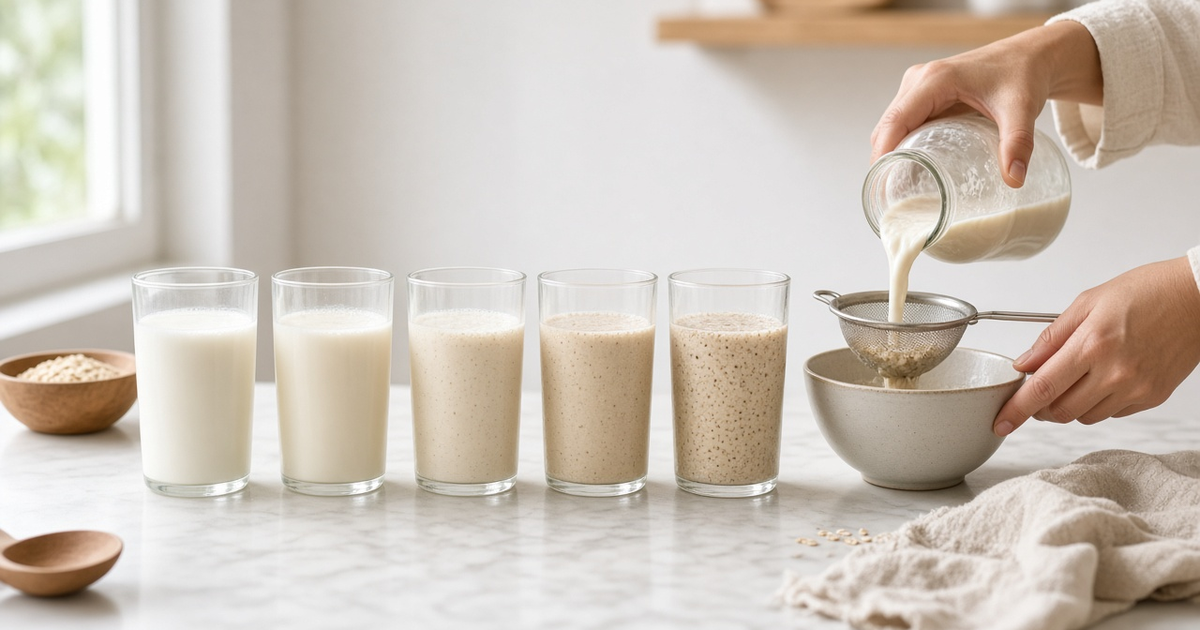
Ultra-processed plant milk is a label pattern, not a brand or a price point. Under NOVA, a plant milk lands in group 4 the moment its list carries something a kitchen does not stock: a gum, a stabiliser, an added oil, a flavouring, or an emulsifier. That is the whole test, and it takes ten seconds on a carton in Alfamart.
The catch is that the test is blunt, and it catches good products as well as bad ones. This article sets out the four NOVA groups, runs the test on the label shapes you meet in Indonesia, and shows where the method stops being useful, including on a fresh bottle from a Bali kitchen.
What NOVA actually measures
NOVA classifies food by how much industrial processing it went through, not by how nutritious it is. The system was developed by Carlos Monteiro and colleagues at the University of São Paulo, and it sorts everything edible into four groups.
| Group | What it covers | A plant milk example |
|---|---|---|
| 1 | Unprocessed or minimally processed: nuts, grains, water, pasteurised milk | Water and cashews, nothing else |
| 2 | Processed culinary ingredients: oils, sugar, salt, vinegar | The coconut sugar and sea salt in a recipe |
| 3 | Processed: group 1 plus group 2, mainly for preservation | A nut milk with added sugar and salt, no additives |
| 4 | Ultra-processed: formulations carrying substances a kitchen does not use | A carton with a gum, an emulsifier, an added oil or a flavouring |
The line between group 3 and group 4 is the one that matters for a shopper, and it is not about ingredient count. It is about whether any single line on the pack is a substance you could not buy at a market.
The numbers are stark. A 2021 analysis of 641 plant-based beverages in the USDA branded food database found that 90.1 percent met the NOVA criteria for ultra-processed food, and 95 percent of the almond milks did. A separate UK market analysis put 84 percent of plant-based milks in group 4, 14 percent in group 3, and only 2 percent in group 1. Both are cited in the peer-reviewed literature on plant-based drinks, and neither is a scandal. They are what happens when a liquid has to survive a year on a shelf.
This article is general information, not medical advice. If you have a diagnosed condition, are pregnant, or are changing a child’s diet, talk to your doctor or a dietitian first.
The ten-second test
You do not need to memorise the groups, only to recognise four families of words and run them in order.
- Find the additive lines. They sit at the bottom of the list, after the water, the nut and the sweetener, because ingredients print in descending order by weight.
- Ask whether a kitchen stocks it. Salt, sugar, vanilla and water are kitchen items. Gellan gum is not. One non-kitchen item is enough to make the product group 4.
- Check the oil. If a refined oil appears above the nut, the creaminess came from the oil rather than the crop.
- Check the front against the back. A carton can say “no artificial preservatives” while carrying a thickener, because a thickener is not a preservative.
The vocabulary you are scanning for is short, and it repeats across almost every carton on an Indonesian shelf:
- Gums: xanthan, gellan, locust bean, guar, carrageenan. They thicken water and stop the solids settling.
- Emulsifiers: lecithin, mono- and diglycerides, polysorbate 80, carboxymethyl cellulose. They hold fat and water together.
- Stabilisers and phosphates: dipotassium phosphate, tricalcium phosphate, sodium citrate. They keep the emulsion from splitting over months.
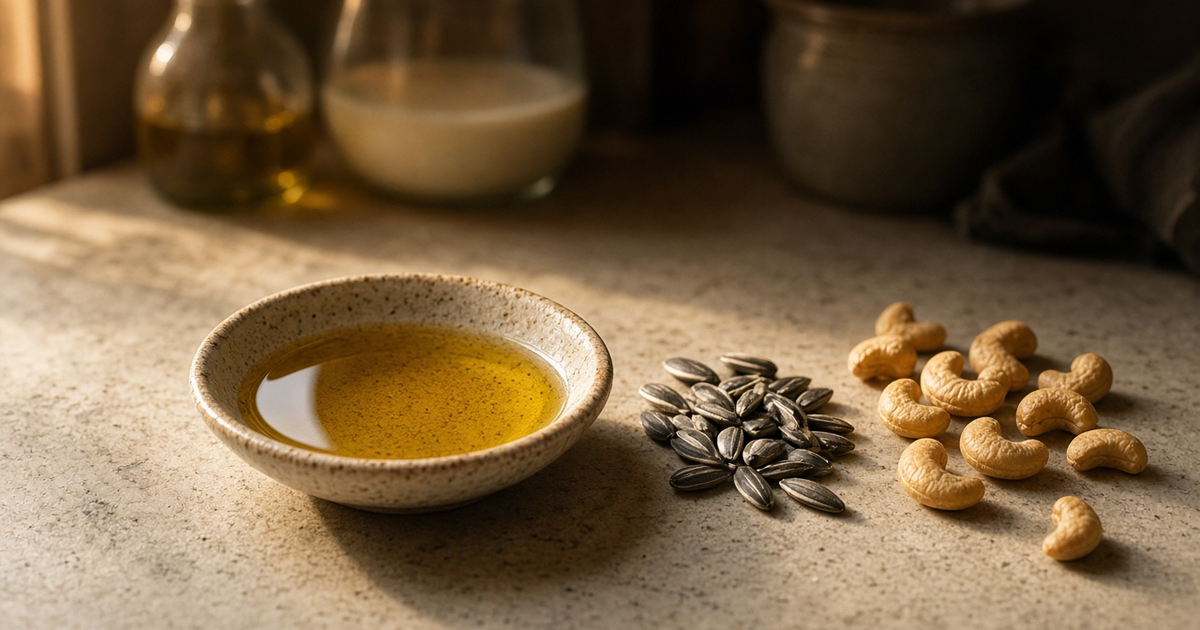
- Added oils: sunflower oil, canola oil, rapeseed oil. They add body and help a barista version foam.
- Flavourings: “flavouring”, “natural flavour”, “flavour enhancer”. A legal umbrella that can cover dozens of compounds.
- Protein isolates: pea protein isolate, soy protein isolate. Protein that was extracted and put back.
- Sweeteners: maltodextrin, glucose syrup, invert sugar, fruit concentrate. All of them are sugar in a different costume.
- Fortification salts: calcium carbonate, vitamin D2, vitamin B12, zinc gluconate. Nutrients added at a factory bench.
Reading a real carton in Indonesia
The format you meet most often in Bali and Jakarta is the imported UHT carton, and its list has a predictable shape: water, the base, an oil, a mineral salt, a gum, a vitamin premix.
Take a typical imported oat carton. Water, oats, sunflower oil, calcium carbonate, dipotassium phosphate, sea salt, gellan gum, vitamin D2, vitamin B12. Nine lines. Four of them are not kitchen items, so the product is group 4 by the strict rule, and it is also the format that survives a container ship and eight months in a warm warehouse.
That trade is real and it is not dishonest. The gum exists because oat starch settles, the phosphate because calcium carbonate drops out without it, the fortification because the base is thin. Each line solves a problem a fresh product does not have, because a fresh product is sold inside three weeks and kept cold the whole way.
The local shelf is the opposite trade. A chilled bottle in a Bali fridge has a short list and a short clock, and the risk moves from the ingredient list to the cold chain. If the fridge failed on the way to your door, a six-ingredient product can spoil in a way a UHT carton cannot.
Where the test breaks
Here is the part the search results leave out. The NOVA rule is strict enough that a single emulsifier flips a product into group 4, and that includes lecithin, a plant phospholipid that occurs naturally in many foods and has been evaluated as safe by the European Food Safety Authority.
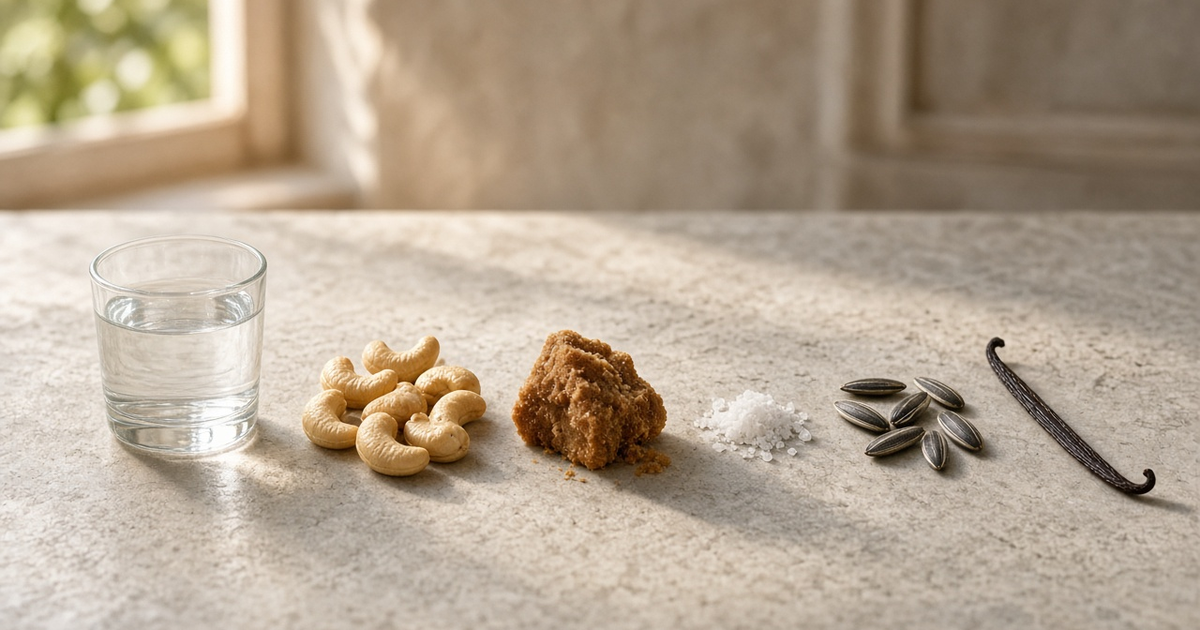
Worry Nut’s own bottle carries sunflower lecithin. Six ingredients: filtered water, Indonesian cashews, Central Java coconut sugar, Kusamba sea salt, sunflower lecithin, Bali vanilla. By the letter of the NOVA rule, that lecithin is enough to put the bottle in group 4, and saying otherwise would be the kind of marketing that makes the whole conversation untrustworthy.
So the honest position is this: NOVA measures processing, and processing is not the same axis as nutrition. A fortified carton with twelve ingredients may deliver more calcium and vitamin D than a six-ingredient fresh bottle, and it will still be group 4. A short list is not automatically better for you.
The category is also more heterogeneous than the label suggests. Group 4 contains processed meat, which carries sodium nitrite and saturated fat, and it contains plant milks, which carry neither. Treating one group as one risk level is a category error, and the review literature on ultra-processed plant foods makes that point directly.
What the test is good for is narrower than a health verdict: it tells you how far a product travelled from the whole food it claims to be. That is a shopping signal, not a diagnosis.
Choose the carton if:
- You need it to sit in a cupboard for months without a fridge
- You are stocking a rental, a boat or a warung with unreliable cold storage
- You want added calcium and vitamin D, and the fortification is the point rather than the flaw
- You are travelling and cannot finish a bottle within four days of opening
Choose the fresh bottle if:
- You will finish it within four days of opening and you have fridge space
- You would rather read six lines you can explain than twelve you cannot
- You are buying in Bali or Jabodetabek, where a cold chain can actually reach you
- You care more about the ingredient list than about shelf life
Neither column is the virtuous one. The carton wins on convenience and fortification, the fresh bottle wins on list length and on the fact that nothing in it exists to survive a year.
A fresh bottle in Bali, read honestly
Worry Nut is a fresh cashew mylk made in small batches in Ubud, and it is a fair test case for this method because the whole recipe fits in one sentence. Filtered water, Indonesian cashews, Central Java coconut sugar, Kusamba sea salt, sunflower lecithin, and Bali vanilla. Nothing else.
It is pasteurised with gentle heat rather than UHT treated, which is why it lives in a fridge and not on a shelf. The cashews are milled fine enough to hold the liquid in suspension without a gum, which is why the list stays at six lines.
Per 200 ml serving, measured by Prodia OHI: 80 kcal, 6 g total fat, 5 g carbohydrate, 2 g sugar, 150 mg sodium, 2 g protein.
Cashew milk is not a nutritional substitute for cow’s milk. Worry Nut carries 2 g of protein per 200 ml serving against roughly 8 g in cow’s milk, and it is not fortified with calcium or vitamin D. If you are relying on milk for those nutrients, plan for them elsewhere.
That disclosure is why the rest of this article can be trusted: a product that admits its own group 4 status and its own protein gap is one you can compare honestly.
Delivery runs chilled across Bali, covering Denpasar, Badung and Gianyar, and through a stockist network in Jabodetabek. Bali orders go through the order page, and same-day delivery applies before 14:50 WITA. Jabodetabek orders go straight to the stockist.
If you want the vocabulary behind the test, the guide to what clean label means builds it from the ground up, and the close read of plant milk ingredients covers each additive family in more detail. For the label mechanics, the ingredient label walkthrough is the practical companion. If you are shopping in Bali, what is actually on the shelf maps the formats.