Dairy Allergy vs Lactose Intolerance: What to Buy in Bali
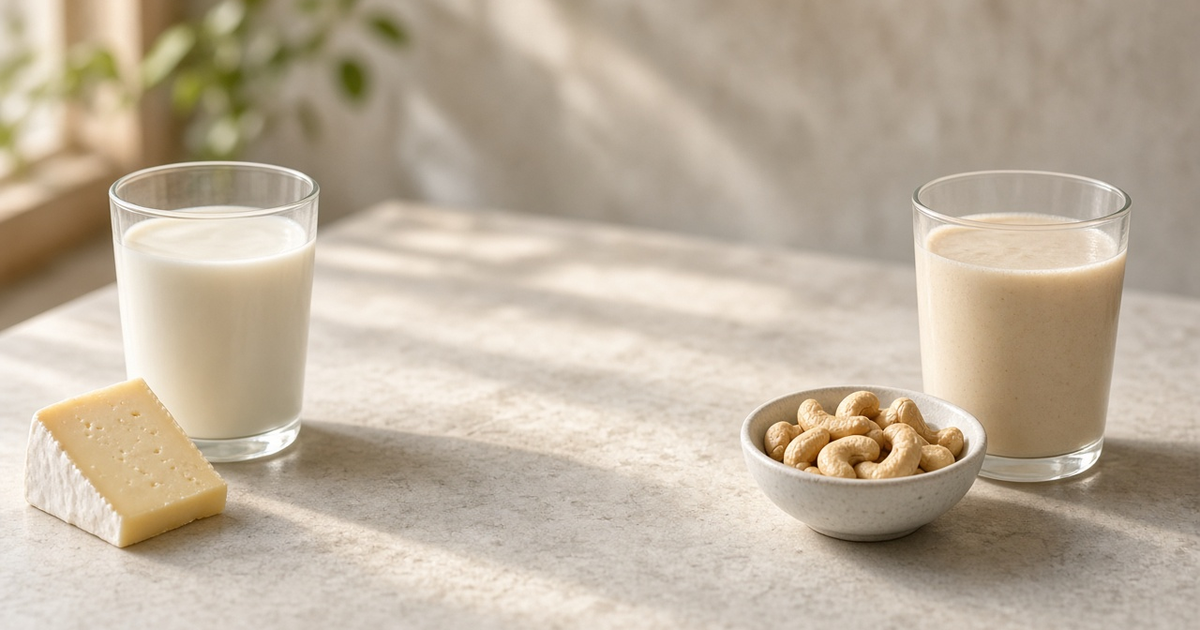
Dairy allergy and lactose intolerance are not the same condition, and the difference decides what you can safely buy. One is an immune reaction to milk protein, which can be dangerous. The other is a shortage of the enzyme that digests milk sugar, uncomfortable but not an emergency.
You drink a glass of milk with lunch in Bali, and by mid afternoon your stomach is tight, gassy and unhappy. You search for an explanation and every result offers the same two names, as if they were one condition with two spellings. This page separates them, then turns the difference into a shopping list.
They are not. One is your immune system reacting to a protein, the other is your gut running short of an enzyme for a sugar. That single difference decides whether a splash of milk in your coffee is fine, whether lactose-free milk helps you or puts you in danger, and which bottle belongs in your fridge.
This article is general information, not medical advice. If you have a diagnosed condition, are pregnant, or are changing a child’s diet, talk to your doctor or a dietitian first.
Two conditions, two mechanisms
Lactose is the sugar in milk. Your small intestine produces an enzyme called lactase to split it into glucose and galactose, which your blood can absorb. When lactase runs low, the sugar passes through intact and colonic bacteria ferment it. Fermentation produces gas, and the unabsorbed sugar pulls water into the bowel, which is where bloating and loose stools come from.
Cow’s milk allergy works somewhere else. The immune system misreads a milk protein, casein in the curd or whey in the liquid, as a threat and produces IgE antibodies against it. The next exposure triggers histamine release, and that can land on skin, airways and gut at the same time.
One condition is a shortage of a tool. The other is a misdirected defence. The Mayo Clinic summary of milk allergy puts the two side by side in those terms, and notes that intolerance does not involve the immune system at all.
A third category fools people. Non-IgE-mediated milk allergy is delayed rather than immediate, showing up two hours to three days after exposure, mostly as gut and skin symptoms. It is common in infants and rare in adults, and it is confirmed by removing milk and watching, not by a skin prick test.
The comparison, one row per decision
The mechanistic distinction is correct, and useless in a supermarket. The rows below change what you put in the basket.
| Decision | Lactose intolerance | Cow’s milk allergy |
|---|---|---|
| What the body reacts to | Lactose, the sugar | Casein and whey, the proteins |
| Immune system involved | No | Yes |
| Typical timing | 30 minutes to 2 hours, dose dependent | Minutes to 2 hours for IgE, 2 hours to 3 days for non-IgE |
| Worst case | A bad afternoon | Anaphylaxis |
| A small amount | Often tolerated, threshold varies | Not a safe assumption |
| Usually starts in | Adults, with a genetic lean by population | Infancy and early childhood, rarely adulthood |
| What clears the problem | Less lactose, or a lactase enzyme | Total removal of milk protein |
| What confirms it | Hydrogen breath test | Skin prick or specific IgE blood test |
Two rows carry most of the practical weight: timing and dose. A reaction that arrives within minutes and ignores the quantity is behaving like an allergy. A reaction that scales with how much you drank is behaving like an intolerance.
What the timing tells you
Timing is the cheapest test you own, and it needs no equipment. An IgE-mediated milk allergy usually produces symptoms within minutes of drinking milk, and almost always inside two hours. Hives, tingling around the mouth, swelling of the lips and wheezing belong to that pattern.
Lactose intolerance is slower. Symptoms arrive between 30 minutes and 2 hours, build with the dose, and fade within hours once the sugar clears. A teaspoon of milk in tea may pass quietly. A large latte on an empty stomach usually will not. If you want the symptom list in more detail, our guide to lactose intolerance symptoms sorts them by onset.
The overlap is the trap: both cause diarrhoea, cramps, nausea and gas, which is why the confusion survives. What separates them is what happens outside the gut, and how much it took to get there.
Any swelling of the throat, difficulty breathing, or a sudden drop in blood pressure is an emergency, whatever the label says. That is an epinephrine and emergency room situation, not a dietary one.
The mistake that costs you money
The expensive error is buying the wrong “free” product, and the two words are not interchangeable.
Lactose-free milk is ordinary cow’s milk with lactase added, so the sugar is already split. The protein is untouched. For a milk allergy that is the same allergen in a friendlier package, which is why allergy guidance says to avoid lactose-reduced products as well.
Dairy-free is the stronger claim, and the one an allergy reader needs. It means no milk ingredient, so no casein and no whey. It does not automatically mean the product came off a line that never saw milk, and that is a separate question you have to ask.
The reverse error is over-restriction. People who suspect an intolerance often remove every dairy food for years, and the resulting diet can run short on calcium, vitamin D, protein and iodine. The NIDDK page on lactose intolerance is blunt that most people with the condition can still handle some lactose.
One more misreading to retire: goat and sheep milk are not the answer for an allergy. Most people who react to cow’s milk react to those proteins too, because they are close relatives.
What changes on the label
This is where the two conditions finally part company at the shelf. With an intolerance you are managing a quantity. With an allergy you are managing a contaminant.
The intolerance list, in the order that saves you time:
- Total sugar per serving: on dairy this tracks the lactose load, since lactose is most of the sugar in plain milk
- Fermentation: yoghurt and aged cheese carry less lactose because cultures have already done part of the work
- Portion, not product: a small amount with a meal often passes where the same amount on an empty stomach does not
- Lactase drops or tablets: a tool you can carry, not a cure, and worth asking a pharmacist about
- Plant milk base: the lactose question disappears once the base is a nut, a grain or a legume
The allergy list, in the same order:
- The word “milk” in any form: milk powder, milk solids, whey, casein, butter, ghee and lactoglobulin all count
- “Lactose-free” as a red flag: it usually still contains milk protein, so it is the wrong shelf
- Shared lines: “may contain milk” and “made in a facility that also handles milk” decide it for a severe allergy
- Bakery, deli and restaurant food: the highest-risk purchases are the ones without an ingredient list
- The substitute’s own allergen: a nut-based milk is a milk-protein-free drink and a tree nut drink at once
Choose the intolerance approach if:
- Your symptoms arrive after a large dose and fade within hours
- You have reacted to milk, ice cream or a latte, but never to a biscuit that lists milk powder
- You want to keep some cheese and yoghurt in your diet rather than remove the category
- No hives, swelling or breathing symptoms have ever appeared
Choose the allergy approach if:
- Symptoms start within minutes, or involve skin, lips, eyes or airways
- A tiny amount has caused a reaction before
- A clinician has confirmed milk allergy by test or by supervised challenge
- You are shopping for a child who reacted in their first year of life
If you recognise yourself in the second list, the shopping rules are strict and they are set by your clinician, not by an article. If you recognise yourself in the first, you have more room than you think, and the guide to lactose intolerance walks through thresholds and swaps in more detail.
What the plant milk aisle actually gives you
In Indonesia the shelf splits into two formats, and the split matters most for an allergy reader.
The imported UHT carton is built for a long sea freight and a warm warehouse. It is shelf stable for months, usually fortified with calcium and vitamin D, and frequently carries a stabiliser, an added oil and a “may contain” line. Some are genuinely dairy-free. Some are oat or soy based and run on equipment shared with dairy.
The fresh local bottle is the opposite trade: shorter list, shorter shelf life, a cold chain you have to trust, and no fortification unless the maker says so. It is not automatically safer for an allergy, because “fresh” says nothing about shared equipment.
For the intolerance reader neither format is a problem, since lactose is a dairy sugar and neither contains dairy. The question becomes which plant milk you actually want to drink. Our ranking of milk for lactose intolerance compares bases and formats. For the allergy reader the label work is not optional: read the list, then the allergy statement, then decide.
The swap that fails quietly
Here is the part the general articles leave out: the plant milk you reach for as a substitute can carry its own allergen.
Cashew is a tree nut. Peanut sits in a different family, but cashew belongs with almond, hazelnut, walnut and pistachio. Milk is the third most common food to trigger anaphylaxis after peanut and tree nut, and children with one food allergy are more likely to have another.
That makes nut-based milks a poor default for a household managing milk allergy, unless a clinician has cleared tree nuts. Oat and rice bases avoid the nut question but bring their own: oat is not gluten-free unless certified.
For someone with intolerance rather than allergy, none of this applies the same way. Same aisle, different question.
Where a fresh cashew mylk fits
Worry Nut is a fresh cashew mylk made in small batches in Ubud, Bali, and bottled in a litre of opaque food-grade plastic so light does not reach it.
It is dairy-free by recipe and lactose-free by recipe, which removes the sugar side of this article and removes milk protein as an ingredient. It is not suitable for anyone with a tree nut allergy. Cashew is the second ingredient on the list.
The whole recipe is six lines: filtered water, Indonesian cashews, Central Java coconut sugar, Kusamba sea salt, sunflower lecithin, and Bali vanilla. No gums, no refined seed oils, no artificial preservatives, no flavouring umbrella. The lecithin keeps the fat suspended, and it is the honest weak point in an otherwise very short list.
The panel below is lab-measured by Prodia OHI, per 200 ml serving.
| Nutrient | Amount per 200 ml |
|---|---|
| Energy | 80 kcal |
| Total fat | 6 g |
| Sodium | 150 mg |
| Total carbohydrate | 5 g |
| Sugar | 2 g |
| Protein | 2 g |
Cashew milk is not a nutritional substitute for cow’s milk. Worry Nut carries 2 g of protein per 200 ml serving against roughly 8 g in cow’s milk, and it is not fortified with calcium or vitamin D. If you are relying on milk for those nutrients, plan for them elsewhere.
That gap matters most for the reader this article is written for. If you have stepped away from dairy, calcium and vitamin D do not follow automatically.
The bottle keeps 21 days unopened at 1 to 4 °C, and is best finished within four days of opening. Shake it before pouring, because there is no gum holding the solids in place. We deliver chilled across South Bali (Denpasar, Badung and Gianyar) and through a stockist network in Jabodetabek, with schedule and cost confirmed over WhatsApp.
If a short list and a cold chain suit how you shop, the Bali bottles are on the order page, same day before 14:50 WITA, and Jabodetabek orders go to the stockist.
What to do this week
Three steps, and no equipment required.
- Log what you ate, how much, and when symptoms started, for seven days.
- Note whether the reaction scaled with the dose or arrived regardless of it.
- Take those notes to a clinician and let them order the test rather than guessing.
A written log answers the questions memory softens, especially the amount. Most people find a threshold, and a threshold is easier to live with than a ban.
Frequently asked questions
Can you have both at once? Yes. The conditions are unrelated, so a person can lack lactase and also react to milk protein. The allergy then rules the shopping list, because it carries the serious risk.
Is lactose-free milk safe for a milk allergy? No. Lactose-free milk is cow’s milk with the sugar already split, so the protein is still there. It is the right product for an intolerance and the wrong one for an allergy.
Do plant milks contain lactose? Not if the base is a plant. Lactose is a dairy sugar, so a nut, oat or soy milk has none unless dairy was added as an ingredient. Check anyway, because some products carry milk solids for texture.
Does a milk allergy go away? Often, in children. Most outgrow it, and the food allergy overview from the ACAAI notes that nearly all infants who develop it do so in their first year. Reintroduction should be supervised, not improvised at home.